Move your mouse over the regions to view their labels. Click on Berlin to see how it was divided. The key is draggable.
After 1945 Germany had become a major problem for the Western allies. As a result of the war, their zones were in economic chaos.
Britain and the USA wanted Germany to recover, as the cost of occupation was very expensive. They also felt that punishing Germany would not help future peace.
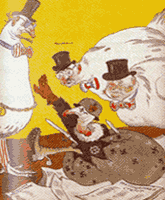
The Russians did not want to rebuild Germany, and Stalin was suspicious of the British and American motives.
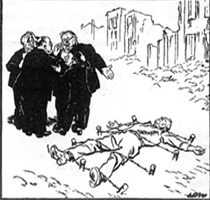
The following cartoons, one Soviet, the other British, show the conflicting issues over the future of Germany.
Cartoon
If we don't let him work, who's going to keep him?
Evening Standard / Atlantic Syndication
By this stage all the Western powers had agreed to the proposed reunification of Germany, in order to reduce the cost of occupation and promote internal economic development.
When the attempts to reach agreement with the Russians on unification failed, a revolution of the currency in the western sector was advocated.
The Soviets opposed the initiative.
The three Western powers nevertheless went ahead with their proposed economic and political reforms. In June 1948 the Deutsche Mark replaced the Reichmark. West and East Germany henceforth had different currencies.
For more than 40,000 pages of
award-winning learning resources, visit learnpremium, the e-learning schools
subscription service, backed by the Guardian at
www.learnpremium.co.uk